Procurement Attractiveness of Pharmaceutical Suppliers: Key Factors Buyers Must Evaluate
The global pharmaceutical industry is undergoing rapid transformation, and understanding the procurement attractiveness of pharmaceutical suppliers has become a strategic priority for importers, sourcing companies, and global buyers. As supply chains grow more complex and regulatory landscapes tighten, making informed procurement decisions is no longer optional — it is essential for business continuity and patient safety.
India's Position in the Global Pharmaceutical Sourcing Market
India has firmly established itself as one of the world's most reliable hubs for pharmaceutical sourcing. Known as the "pharmacy of the world," India supplies over 20% of global generic medicines by volume. Its combination of low manufacturing costs, a large pool of skilled scientists, and robust regulatory compliance has made it a preferred destination for global buyers evaluating procurement attractiveness of pharmaceutical suppliers.
Indian manufacturers hold the highest number of US FDA-approved pharmaceutical plants outside the United States, making the country a credible partner for regulated markets in North America, Europe, and beyond.
Key Product Categories and Segments in Pharmaceutical Procurement
When assessing procurement options, buyers typically evaluate suppliers across several core segments:
Pharmaceutical Products Generic drugs form the backbone of India's pharmaceutical exports, including tablets, capsules, injectables, and biologics. APIs (Active Pharmaceutical Ingredients) are another critical category, with Indian firms supplying APIs to manufacturers worldwide.
Medical Devices and Diagnostics From diagnostic kits to imaging equipment, the medical device segment has grown significantly, supporting hospital procurement globally.
Wholesale Surgical Products The market for wholesale surgical products — including disposable gloves, sutures, surgical instruments, and sterilization equipment — has seen strong demand from hospitals, clinics, and government health agencies. Indian suppliers offering wholesale surgical products are increasingly competitive in both quality and pricing.
Nutraceuticals and OTC Products Vitamins, supplements, and over-the-counter health products represent a fast-growing procurement segment, particularly post-pandemic.
Export Performance and Statistics
India's pharmaceutical export performance demonstrates its scale and reliability as a supplier base. The figures below represent estimated sector-level data based on industry reports:
Category | Estimated Annual Export Value (USD) | Key Markets |
Generic Medicines | $14–15 Billion | USA, UK, South Africa |
APIs & Bulk Drugs | $3–4 Billion | China, USA, Germany |
Wholesale Surgical Products | $1.5–2 Billion | UAE, USA, Southeast Asia |
Medical Devices | $2–3 Billion | USA, Europe, Middle East |
Nutraceuticals & OTC | $800 Million–$1 Billion | USA, Australia, Canada |
These numbers reflect the breadth of India's pharmaceutical sourcing capabilities, offering buyers diverse procurement options under a single geographic footprint.
Major Export Destinations and Global Demand
The procurement attractiveness of pharmaceutical suppliers from India is most evident in the diversity of its export destinations. North America accounts for the largest share, driven by generic drug substitution programs and cost-containment policies. The European Union is a highly regulated but valuable place to do business, and Indian suppliers always meet EMA and WHO-GMP standards.
Emerging markets in Africa, Southeast Asia, and Latin America present growing procurement opportunities, particularly for affordable generics and wholesale surgical products. The Middle East, especially the UAE and Saudi Arabia, has become a major hub for moving pharmaceuticals around Africa.
Strengths of Indian Pharmaceutical Suppliers in Global Procurement
Several factors enhance the procurement attractiveness of Indian pharmaceutical suppliers:
Cost Competitiveness Manufacturing costs in India are significantly lower compared to their Western counterparts—sometimes 30–40% less—without compromising quality or compliance.
Regulatory Accreditations A large number of Indian facilities hold approvals from the US FDA, UK MHRA, WHO-GMP, and EU GMP authorities. These accreditations directly reduce procurement risk for international buyers.
Skilled Scientific Workforce India produces over 50,000 pharmacy graduates annually, providing a strong talent base that supports R&D, quality control, and manufacturing scale-up.
Wide Product Portfolio Buyers engaged in pharmaceutical sourcing benefit from the ability to consolidate orders across generics, APIs, diagnostics, and wholesale surgical products from a single country, reducing logistics complexity.
Strong IT and Supply Chain Infrastructure Modern cold chain logistics, real-time tracking, and ERP-integrated supply chains have substantially improved order accuracy and delivery timelines.
Industry Challenges Affecting Pharmaceutical Procurement Decisions
Despite its strengths, buyers must be aware of challenges that can affect procurement reliability:
Regulatory Scrutiny Indian manufacturers have faced import alerts and warning letters from regulators, particularly the US FDA. Buyers should conduct thorough supplier audits before finalizing procurement agreements.
Pricing Pressure and Thin Margins The generic drug market is highly price-competitive, which can sometimes incentivize cost-cutting measures that impact product quality if suppliers are not carefully vetted.
Raw Material Dependency A significant portion of API raw materials is sourced from China. Geopolitical tensions or supply disruptions can create volatility in pharmaceutical sourcing timelines and pricing.
Intellectual Property Concerns Buyers procuring patented formulations or novel technologies must ensure clear IP agreements are in place with Indian suppliers.
Sustainability and Future Outlook for Pharmaceutical Suppliers
Sustainability is becoming a key dimension of the procurement attractiveness of pharmaceutical suppliers. Buyers increasingly evaluate suppliers on their environmental, social, and governance (ESG) performance. Indian pharmaceutical companies are responding by adopting green chemistry practices, reducing water and energy consumption in manufacturing, and securing ISO 14001 certifications.
The Indian government's Production Linked Incentive (PLI) scheme for pharmaceuticals has allocated significant capital to boost domestic API manufacturing and reduce import dependence, strengthening long-term supply security for global buyers.
Looking ahead, the global pharmaceutical outsourcing market is projected to grow at a CAGR of approximately 7–9% through 2030. Indian suppliers are well-positioned to capture a larger share of this growth, particularly in biosimilars, complex generics, and specialty wholesale surgical products.
Conclusion
Evaluating the procurement attractiveness of pharmaceutical suppliers requires a multi-dimensional approach that goes beyond price comparison. From regulatory compliance and product quality to sustainability practices and supply chain resilience, global buyers must examine every layer of a supplier's capability. India remains one of the most compelling destinations for pharmaceutical sourcing and wholesale surgical products, offering a rare combination of scale, quality, and cost efficiency.
As the global healthcare supply chain continues to evolve, buyers who invest in rigorous supplier evaluation will be best positioned to secure reliable, compliant, and cost-effective procurement partnerships.
FAQs: Pharmaceutical Sourcing and Supplier Evaluation
Q1. What certifications should buyers look for when evaluating pharmaceutical sourcing partners?
Buyers should prioritize WHO-GMP, US FDA, EU GMP, and ISO certifications. For wholesale surgical products, CE marking and ISO 13485 are critical compliance benchmarks.
Q2. How can buyers assess the procurement attractiveness of pharmaceutical suppliers?
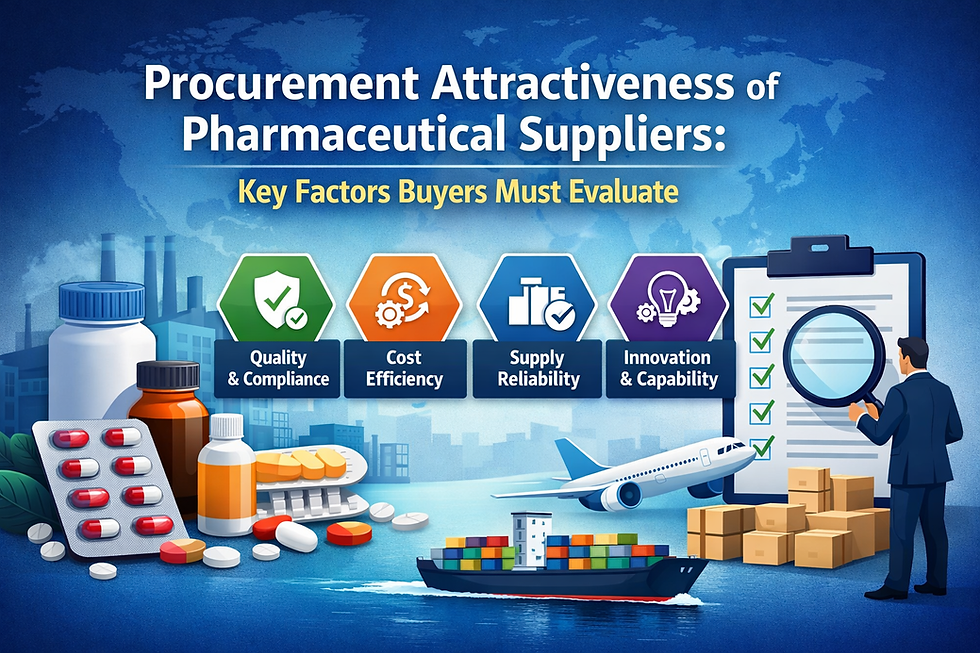
Key evaluation criteria include regulatory accreditations, production capacity, quality management systems, financial stability, past export records, and responsiveness to audits.
Q3. Is India a reliable source for wholesale surgical products?
Yes. India has a strong and growing cluster of surgical product manufacturers offering competitive pricing, CE-compliant products, and established export networks to over 150 countries.
Q4. What are the risks in pharmaceutical procurement from emerging markets?
Common risks include regulatory non-compliance, inconsistent quality, supply chain disruptions, and IP issues. Conducting supplier audits, requesting third-party lab reports, and maintaining dual-sourcing strategies can mitigate these risks.
Q5. How is sustainability influencing pharmaceutical sourcing decisions?
Buyers are increasingly factoring in carbon footprint, wastewater treatment practices, and ethical labor standards as part of their supplier scorecards, aligning procurement with broader ESG goals.


Comments